
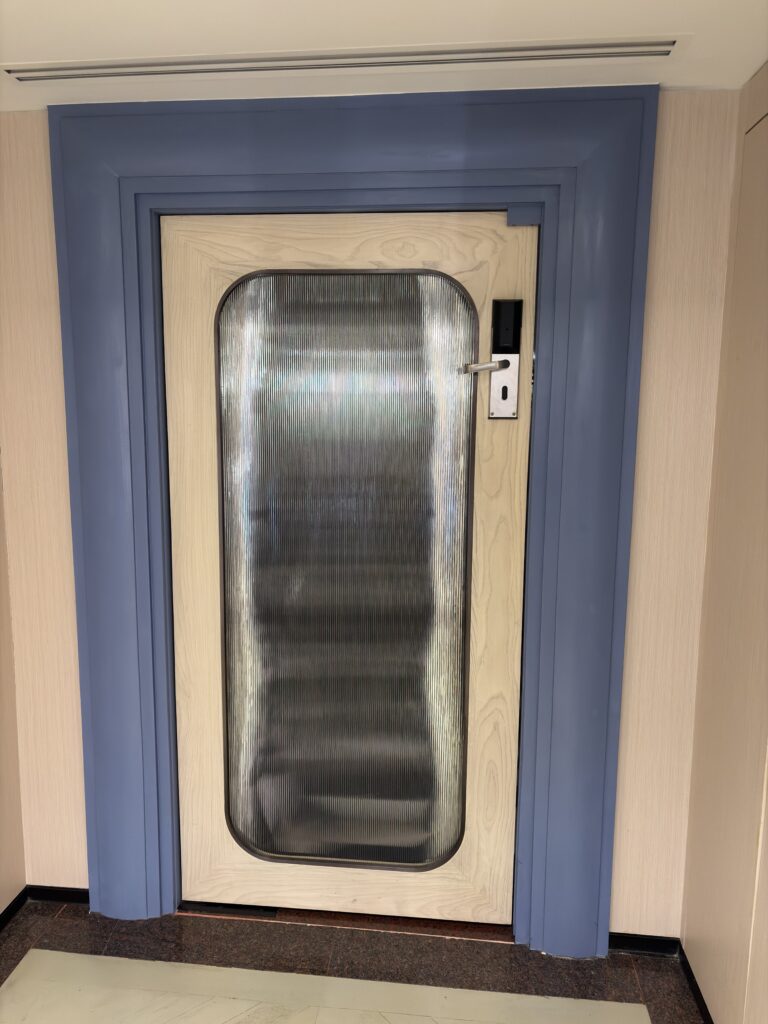
‘It’s not so uncommon to seek thrills where thrills can be safely sought. Scary movies. Roller coasters. Strip clubs. Each comes near enough to the shape of danger to be satisfying to the majority and the price of entry is low.
The minority take it a little further and they sometimes pay a greater price.
‘The Exhibit of Household Risk’ falls into the latter category, but its location does it no favors. Those individuals risking travel through The Crease are usually inured to the petty dangers it further softens, and the thought of home further repels them.’
Harsh words by the Guide, if you ask me. I have no problem thinking of my home. I run nostalgic at times. But it’s true that the thought of going back, the thought of trying to resettle in my life before all this leaves me feeling… what? Shame maybe. If there is a mold of me there, I don’t think I would fit it anymore.
These are the thoughts that come to me as I slip my hand into garbage disposal that, according to the sign nearby, is absolutely functional. The switch for turning it on is just below the sign and a red glowing light further indicates that the system is powered. Thankfully, the switch is encased in a plexiglass box and further signage details various electric fail-safes that ‘The Exhibit’ has had installed behind the scenes. Breakers and such.
A map of ‘The Exhibit’ indicates that if I’m able to complete a series of tasks I’ll receive a free bumper sticker, and though I would never place a bumper sticker on my trailer, I can’t resist a thing that is free. The task here is to retrieve a wedding ring ‘dropped’ in the sink and I’m feeling around the blades, which I assume are artificially moistened at the beginning of each day, when the whole exhibit shudders and the motor roars to life and my eyes are leveled not at the switch but at the specs of the disposal which indicates it can process the appropriately cubed corpse of a pig in less than a minute, bones and all. Somehow I have enough time to imagine my ambulance ride to the hospital, the pain and then the shame of leaving discretely so I wouldn’t have to pay, the rest of my life without a left hand including a proposal by some faceless potential fiancé, before I realize there is no movement at all against my hand.
The exhibit stops shaking. The motor quiets. Sweat trickles down my back, and I recognize, after a beat, that it was all for show. A sound effect and some sort of industrial vibrating device.
I pull my hand out and step backward into an employee that has appeared behind me.
Sheepish, he ducks around my body and drops a gold ring into the drain. “Forgot to reset this one earlier.”
-traveler
‘There is only one point through which all American trains pass through the Crease. It’s there only because it must be. The Crease bisects the nation, and goods must be moved.
And within the Crease and on the tracks there is one railroad switch that sends trains east or west out of the Crease, depending upon its orientation. It is the only ‘Public Access Railroad Switch’ in America and people use it freely.
It used to be fun, because nobody knew what was on each train, but in these days of the internet, these days of interconnectedness to toxicity, we know what is being moved and when. And people want those things.
People use the Switch freely, still, but it isn’t fun anymore. Such is the danger of knowledge.’
-an excerpt, Autumn by the Wayside
A figure already stands on the opposite side of ‘The Trust Bridge’ when I arrive. They are framed by the railings, looking from a distance as though they stand hesitant, like me, on the last step before the bridge leaves the ground. One arm is limp at their side. The other is on the railing or on the post just before the railing. The post with the release button.
More than the hand placement, though, it’s the person’s readiness that makes me hesitate. And I am hesitating in a position that might as well be a mirror image of the person across from me except that I know my own feet are still on the ground and I know my hand grips the railing and does not hover over the button which, in this position, is behind me.
I wave to the man- I think it’s a man- and he waves back after a second’s pause. I shout my intention to cross the bridge and he waves me forward but does not move. Does not shout. His left hand settles at his side. His right hand settles ambiguously, again, on the bridge itself.
The bridge has stood for thirty-odd years. Hundreds have crossed it in either direction, putting their lives in the hands of those crossing the opposite way. Some of those people have crossed because they don’t believe the buttons will actually drop the bridge. Some of these conclusions are founded on technical examinations of the button posts and the bridge itself. Some of these conclusions rely on the legality of the bridge- the assumption no government would allow something so dangerous to exist so openly. Nobody believes they nay-sayers. To believe would make the cross less special. Less scary.
I mime walking in a way that’s almost clownish and the man across from me drops the bridge, ending a decades old tradition.
I watch the Wayside destination fall into the gorge and shatter on the rocks below with a detachment I realize, belatedly, is shock. I throw up suddenly and violently, all my adrenaline used up in a single go.
By the time I’m finished, the man is gone.
‘Statistically speaking, every bridge has a 100% success rate until it fails. For better or worse, there’s no reason to think the same isn’t true for ‘The Trust Bridge.’’
After I’ve cleaned myself up. After I’ve become paranoid and searched the woods around me for the man who I think, for a wild moment, might intend to finish his unfinished job. After I’ve pack and re-packed my things and wrung my hands and searched for a cellphone signal, I turn back to the path and start in the direction of the camper. Night comes early in The Crease and there’s plenty the Guide doesn’t speak about. Plenty that is dangerous and strange that is not a destination.
Before I leave the clearing, though, I turn back again and set my phone camera to film. I walk to the post and press the button, releasing the torn remnant on my side of ‘The Trust Bridge’ into the gorge. Once I have service, I’ll find a place to post it where those who’ve walked the bridge can see. They’ll know, at least that it was special.
That it was scary.
-traveler
‘‘Ask ye not what dread society dwelt once yonder…’
This is the warning carved into an ancient plank of wood that hangs over the entrance to ‘The All-American Cement Quarry.’ Beyond it, one can see that it doesn’t look like a quarry at all.
‘The All-American’ looks like a field of statues, massive and ancient and uncanny in that these figures appear humanoid, at a glance, and alien upon study, their ratios not quite right. Their balance strange and their emotions guarded. These statues are privately owned and their owners are in the process of powdering them. The resulting product is considered the highest-grade cement available on the global market.
Historians have attempted to regulate the destruction of these relics, of course, but Capitalistic Democracy is a one-way machine and, having won the right to powder these stone figures in a short appeal in the early 1900s, the landowners rely on established precedent to protect their income and have done so to great success. The plank’s message is said to pre-date the claim and the plank itself is a replica, now ancient, of what was found there at the earliest point in which ‘The All-American’s’ history was recorded. Whether or not the original message continued past these nine cryptic words is a matter of debate, but they seem to have shaped the fate of the land.
Nobody gets to ask questions about the statues or the beings that made them.
A short clip of a teenage boy recently went viral. He is bleeding from the nose and appears, briefly, to levitate in the air before collapsing. On the ground, his hair waves wildly as though blown by a sudden and personal gust of wind. Details about this event suggest that the boy powdered and snorted a small section of a cement wall with origins in ‘The All-American,’ and though this may not be true, the quarry is facing its first crisis since the appeal as teens descend upon the buildings it has produced and, in some cases, upon the statuary itself, looking not for a high so much as interesting content for their feeds.’
-an excerpt, Autumn by the Wayside
I’ve never been very good at the places where you’re supposed to find something other than the destination. I didn’t have much luck at the diamond fields or any of the presumed meteor landing sites. Panning for gold, I never found anything but mud and rocks. When I find something it tends to be a nasty surprise- usually what’s left of whoever came before me. I suppose that’s its own kind of luck.
I try to learn from their mistakes.
‘Travelers will want to confirm their tetanus vaccinations before attempting to comb ‘The Lure Trench,’ a narrow valley in the already-recessed Crease. ‘The Lure Trench’ might have been a mainstream destination if not for the danger it presents. And for the smell. It is geographically interesting in that it remains so narrow despite a large majority of the country’s fresh water passing through it. This is due, in part, to the porous rock formations that precede it, these acting to lower the water pressure to a trickle so that, despite the filtration, the water stagnates and runs still. Those fish who attempt to pass through ‘The Lure Trench’ rarely survive and their bodies further thicken the waterway.
Evolutionarily speaking, these fish should have learned their lesson by now but this too can be explained by the relatively mundane. The mountain at the far side of ‘The Lure Trench’ (which also serves as the safest and most accessible viewpoint into the Crease) emits a magnetic field and the fish that choose to attempt ‘The Lure Trench’ all have one thing in common: they carry metal.
It’s fishhooks, mostly, all of them sharp despite the rust. But among those hooks are lures and any fisher worth their rod will tell you that good lures are lost to the sport all the time. These lures can be expensive and rare and there are collectors out there willing to pay a fortune for something that can be dug up for free (discounting personal safety).
Leave your magnets and your metal detectors at home. They work too well, here, failing to differentiate between the trash and the treasure. Travelers hoping for a souvenir should search with a partner and both should prepare for difficult, bloody work.’
The few men in ‘The Lure Trench’ when I arrive bleeding freely from their feet and legs, where hooks and lures hang by shallow folds of flesh. I’ve read that dedicated searchers here forgo protective garments after a few days. Cloth beneath the knee snags and slows them down, trips them up. Offers minimal protection. When something catches their legs they know right away, can stop to see whether it’s worth extraction in the moment or if it can wait until a break.
I watch some of the men pull lures from the shallow, stinking muck that technically constitutes a river. Sometimes, when they are impressed, they plug them into their arms. It serves to differentiate them from the refuse, I suppose. And it gives them status.
These people are not well.
I don’t move beyond the shore but as I’m starting back on the path to the Crease’s main thoroughfare I feel a sharp, plucking sting in my heel. A deep red lure with bright white eyes stares up from the back of my shoe, where its hook disappears into the fabric. It takes me an hour to remove because I am a baby about these things and because I refuse to give it up to the men who see me struggling, who offer to help if I’m willing to give them the find.
I carry it back in my hand because I’m afraid it will burrow into anything I try to store it in. Back at the trailer, I drop it into a glass bottle from the side of the road. The smell makes me want a beer for the first time in months. The bottle goes into the cup holder while I patch up my heal, wondering where I’d even begin finding my medical records without the help of my family.
Someone at home would know whether this might kill me.
Nobody at home knows I’m still alive.
Some people have tried to draw parallels between the number of metal fillings one has and their willingness to search ‘The Lure Trench’ for profit. Just like the fish, the more metal one carries, the more likely they are to find themselves in water no sane creature should want to brave. The contrary opinion suggests a third variable and a cause for both: desperation via poverty.
Whatever the cause, I fit neatly within that correlation: my mouth largely alloy, my foot still bleeding from ‘The Trench,’ my finances a wreck.
I would prefer to know that I do this against my own free will but it seems too easy to be true.
-traveler
Recent Comments