
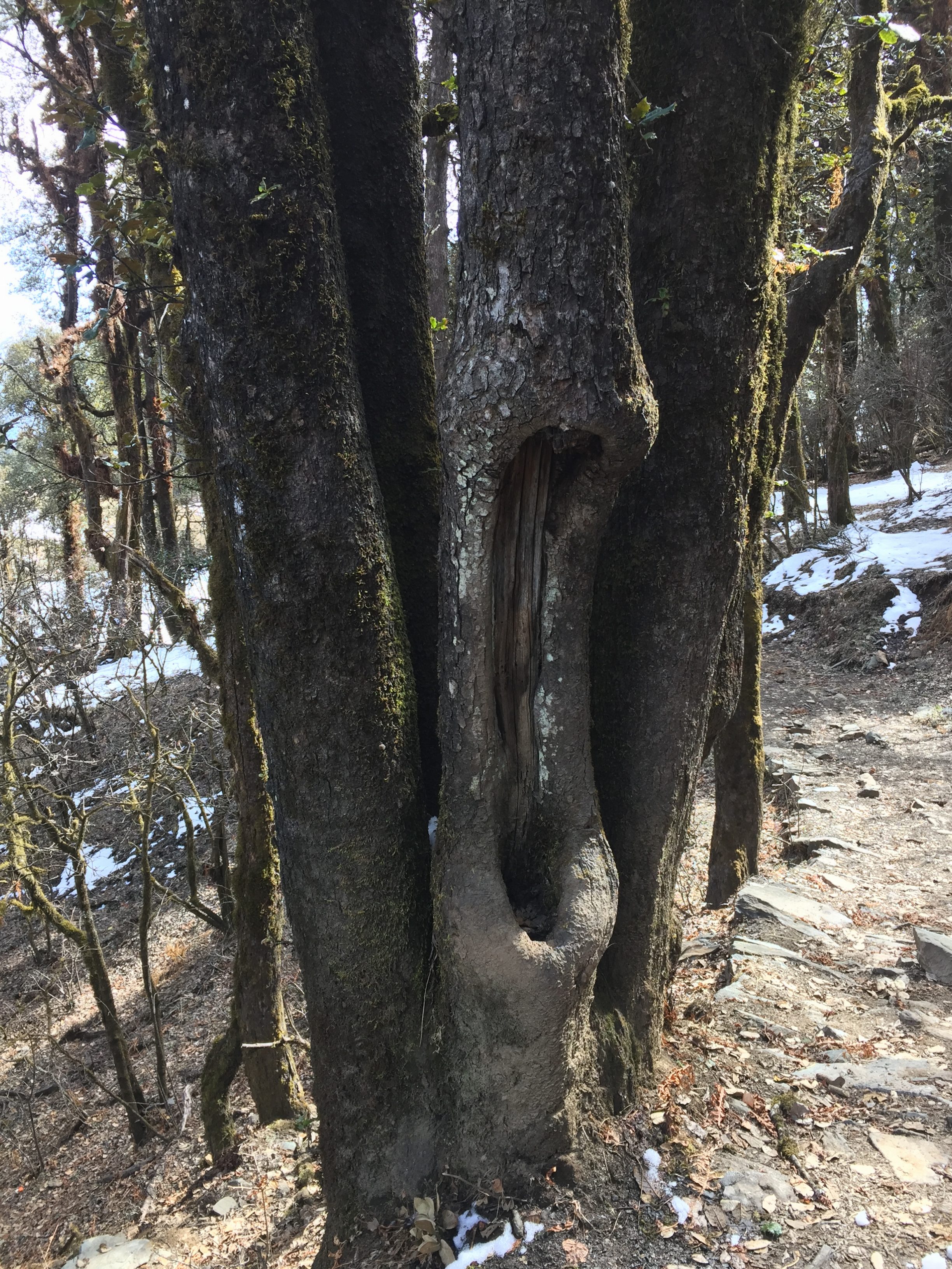
I imagine the person who coined ‘Brick-Point 43.8554° N, 102.3397° W’ thought they were being clever. Like most things that seem clever in writing but are normally unsaid, ‘Brick-Point 43.8554° N, 102.3397° W’s name is obnoxious and not really all that clever at all. Going forward I will call it: ‘Brick-Point,’ with the understanding that we are talking about this, specific, point and no other, differently-coordinated, point.
A point of bricks.
The ‘Badlands’ are not an easy place to visit for the carless traveler and this carless traveler does not wish to improve or challenge himself- motivations that might make the difficulty more palatable to a certain type of person. What it means, for me, is the social discomfort of hitchhiking followed by the physical discomfort of sleeping on the ground. A ground peppered with rocks and bones.
Night, in the ‘Badlands,’ is quiet, but in that quiet, relative to it, quiet things become loud. The sand readjusts itself. The wind readjusts the sand. Things contract in the cold. Other things crawl or roll or fly overhead. I learn, early, to turn off my light. It serves only to attract what passes for life in the dry, cracked earth. There is nothing much to see anyway.
I sleep fitfully and wake with a start to a brightly lit morning.
The ‘Brick-Point’ is still several miles away.
‘‘Brick-Point 43.8554° N, 102.3397° W’ is, nearly always, a massive pile of bricks. Like other pilgrimage pieces, it grows as people visit and add their own bricks to the pile- bricks they’ve purchased, bricks they’ve found, but more often than not, bricks that were once a part of something they loved.
It is a resting place for bricks and a memorial to the structures they were once a part of, though it may not always seem that way.
Some corner of the internet has adopted ‘Brick-Point 43.8554° N, 102.3397° W’ as an art piece so, when it is not a pile of bricks, it is sometimes a house or several small houses. Other times it is a massive brick word, barely legible from the tallest nearby dune. Once, with careful use of forced perspective, it was made to look as though no bricks existed there at all.
The pile has taken several forms over several decades but, like the phoenix, an avatar of entropy, its destiny is to crumble again and again, no matter the energy it wastes in cohesion.’
A bold statement by the author of Shitholes. I wonder if they’re his words or if he lifted them off the artist’s forum, the one that associates itself with this place. I had a look at it back when my phone had service and, suffice to say, the ‘avatar of entropy’ bit would be right up their alley. Maybe he’s just trying to sell books.
‘Brick-Point’ is pain to get to but it’s not hard to find. With the coordinates plugged in and a general heading, it’s only a matter of following the path of least resistance. I pack up and start to walk, picking my way over and around the barren landscape.
An hour later I spot a line in the distant sand and I groan. It is, undoubtedly, the work of artists- it reeks of art school, burning man, and sweat. Worse, it looks fresh- a uniform black line across the red-brown wastes of the ‘Badlands.’ Paint? Paper? Reclaimed garbage bags?
No.
Shadow.
I arrive at the line and see it is not ‘in the sand’ at all. It is a long, uniform, shadow stretched impossibly far. I check my coordinates and follow it because it is, almost certainly, leading to ‘Brick-Point 43.8554° N, 102.3397° W.’
An hour on and I am able to make out the source of the shadow; another line, this one also impossibly long but stretching from the horizon into the sky. I squint against the sun but cannot make out its terminus.
An hour later I arrive at ‘Brick-Point’ and find it abandoned. The bricks have been stacked, one on top of the other over and over again. They disappear into the sky. I examine the tower closely but cannot make out the use of adhesive. There may be an internal structure but even a metal bar would sway and bend eventually. I look around, expecting to see someone, wishing someone was there to share in the wonder and terror the impossible brick structure invokes within me. I try, again, to make out the top and experience a sympathetic vertigo.
I fall over and am glad to be alone.
There is a small slip of paper wedged under the bottom-most brick, folded there very carefully. Something is written on the inside, I see, but I cannot make out what without disturbing it.
I hem and haw for a while. I approach the tower and step away again. As the sun rises in the sky the long shadow draws back to its caster. I look again at the paper. It is only folded once. It is not thick, not a wedge for balancing out some rickety chair. It is, most certainly, a note.
I kneel and pull the note out from under the brick. It slips easily into my hand. There is a noise like a heavy footstep some distance away as I unfold the paper. It says:
‘RUN’
A brick falls into the sand nearby.
-traveler
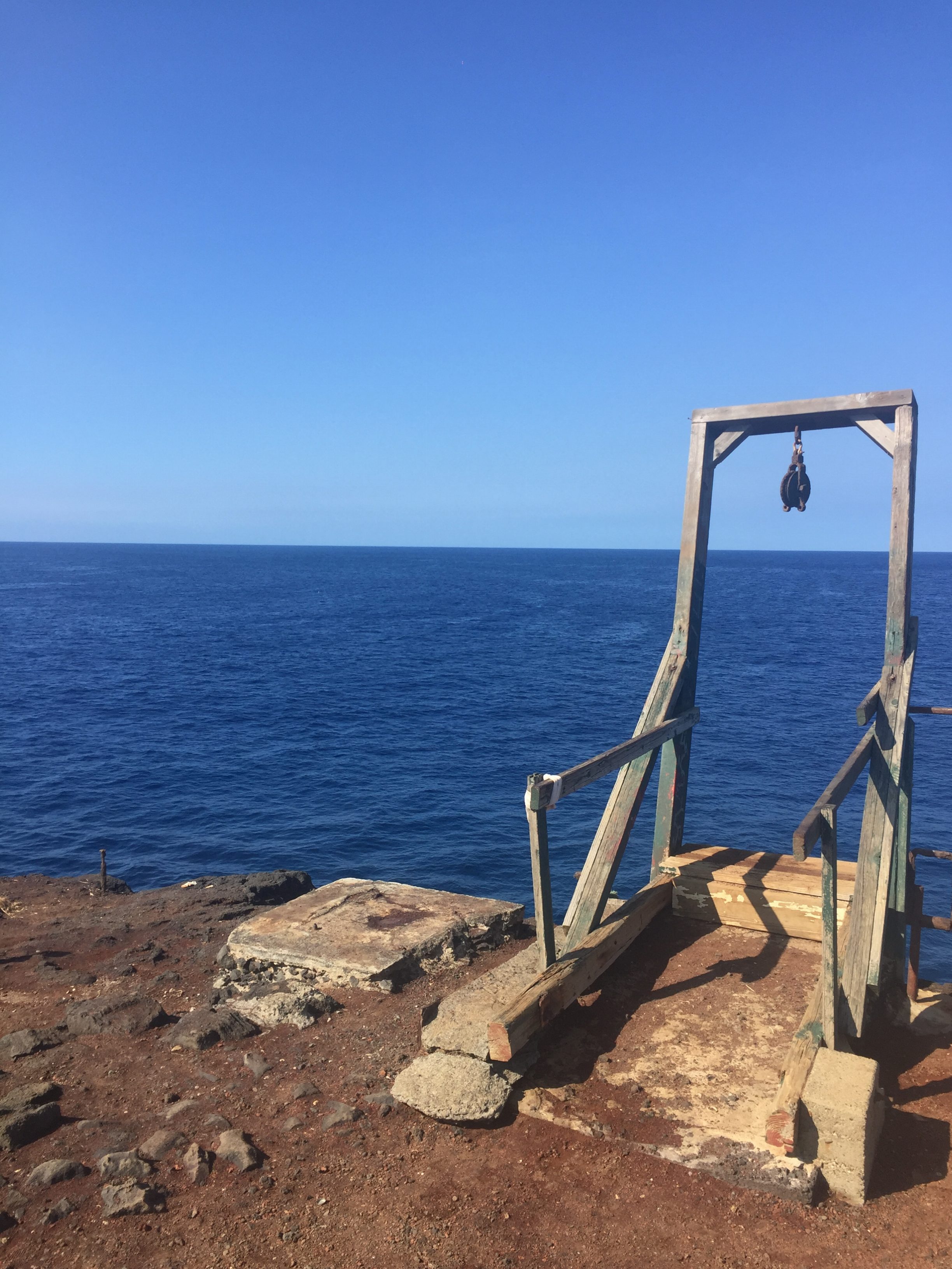
‘The Lathe’s Court’ is unattended and difficult to find. Some suggest it has been abandoned and, by all accounts, it seems to be, though the governing rules of roadside art are historically vague and the degradation may be part and parcel of the show. It shares the traits of its kin (car-henges and cement dinosaurs alike) in that it professes no statement of purpose and bears no clear signature. ‘The Lathe’s Court,’ like the others, simply exists to be witnessed and will continue to draw the occasional pilgrimage until the trees shake off their tending.’
The Lathe’s Court is easy enough to find at sunset.
I’ve taken to editorial scribbling in Shitholes since the stranger’s phone has been disconnected. It may be convenient to have notes if a second edition ever rolls out, or, if I happen to find a second edition already existing somewhere, it may be convenient to have something to compare. I still have a lot of questions about all of this, even though I don’t ask them as often as I once did.
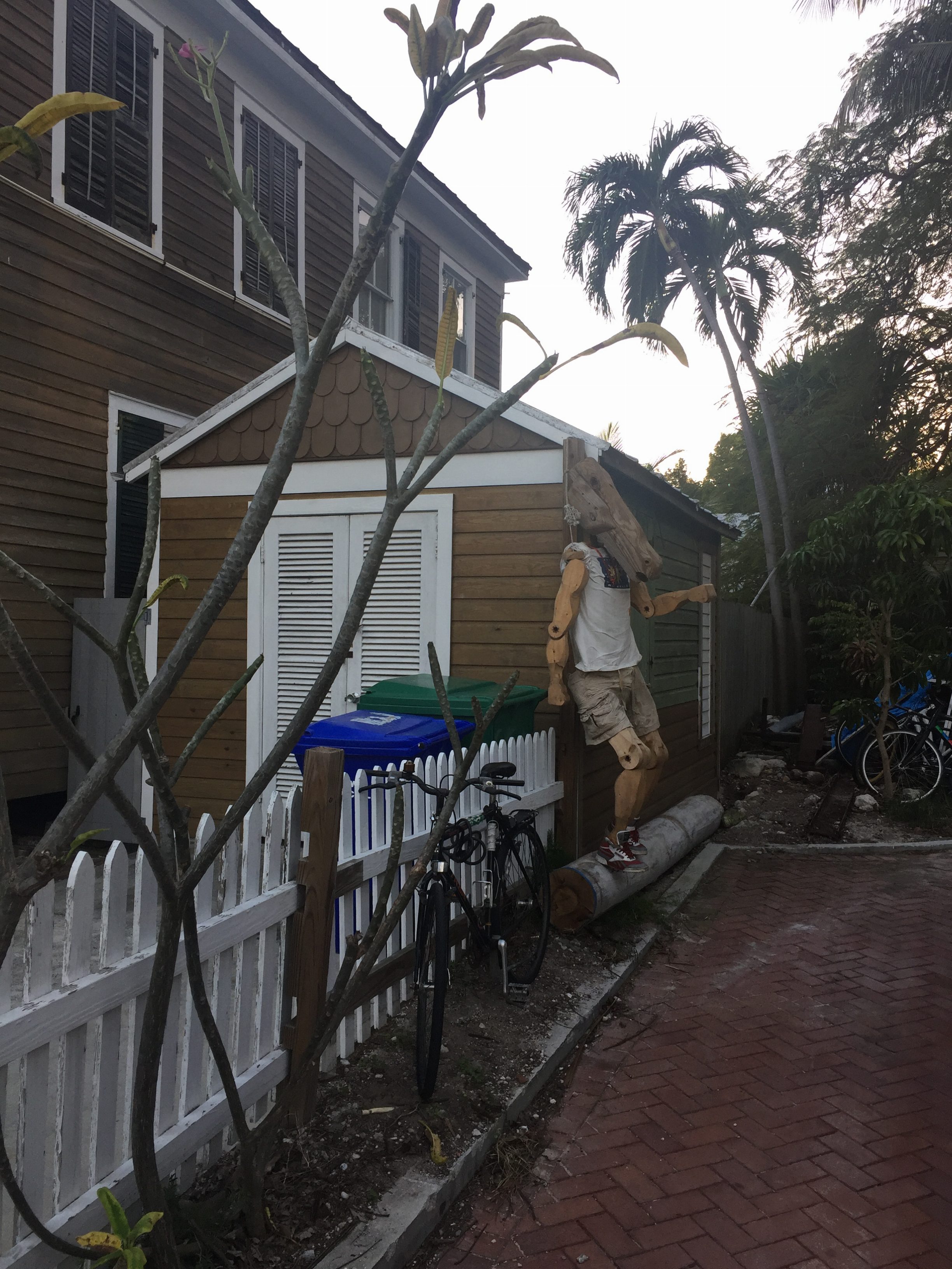
‘The Lathe’s Court’ (where a ‘lathe’ is a woodworking machine) is easier to find at sunset because the artist’s statues, which have been carved into the still-living trunks of trees, continue to grow. The ‘Lathe Dancers’ (where ‘dancer’ is one of the many carved human figures in the ‘court’) have risen well above the ground and hover sparsely in the branches. The setting sun, for a few moments each evening, reveals them by their shadows.
Easy enough, but eerie.
Eerie if, like me, you don’t know what you’re looking for and if you assume, like many would, that the court remains unwarped and at ground level. Eerie if, like me, you rest underneath them to pour, frustrated, over a hand-drawn map. Eerie if, like me, you look up to see the shadows there, suddenly. Eerie if, like me, you are alone.
Time, but not decay, has taken its toll on ‘The Lathe’s Court,’ stretching the limbs and features of the figures there into uncomfortable silhouettes. Their skin has become rough with bark, their mouths sealed shut or awkwardly gaping. Arms and legs have grown new joints, collarbones collect the canopy’s rotting detritus. Some have become host to animals, others to birds, but, in the sun, they are what they were, they remain human-enough.
I climb a tree to look at one and hang, for a moment, my arms around a woman’s waist.
“This is new,” I joke to her.
She creaks under my weight.
There is a man ahead of us, a ‘Lathe Man.’ The tree’s life has emphasized the man’s posture; he was carved to be proclaiming something, his arms spread out, grown far beyond any possible model.
The court is vast and layered, its ‘dancers’ spanning elevations and poses. They disappear in the twilight, dissolving back into the chaos of twigs and branches. Darkness obscures everything but the odd limb.
I take a different way out- I’ve lost the path but I know which direction the road is. These days I don’t mind being a little lost. I come upon a fallen tree, a fallen ‘dancer.’ A lightning strike has severed her connection to the earth. In the air, as she was carved, the ‘dancer’ may have been reaching for an embrace. I scour the treetops above us with my light but find no partner there. On the ground, having fallen forward, she seems to crawl. Her mossy arms bend awkwardly, failing, over the years, to hold the weight of her trunk.
She faces the road but the road, I know, is several miles ahead.
-traveler
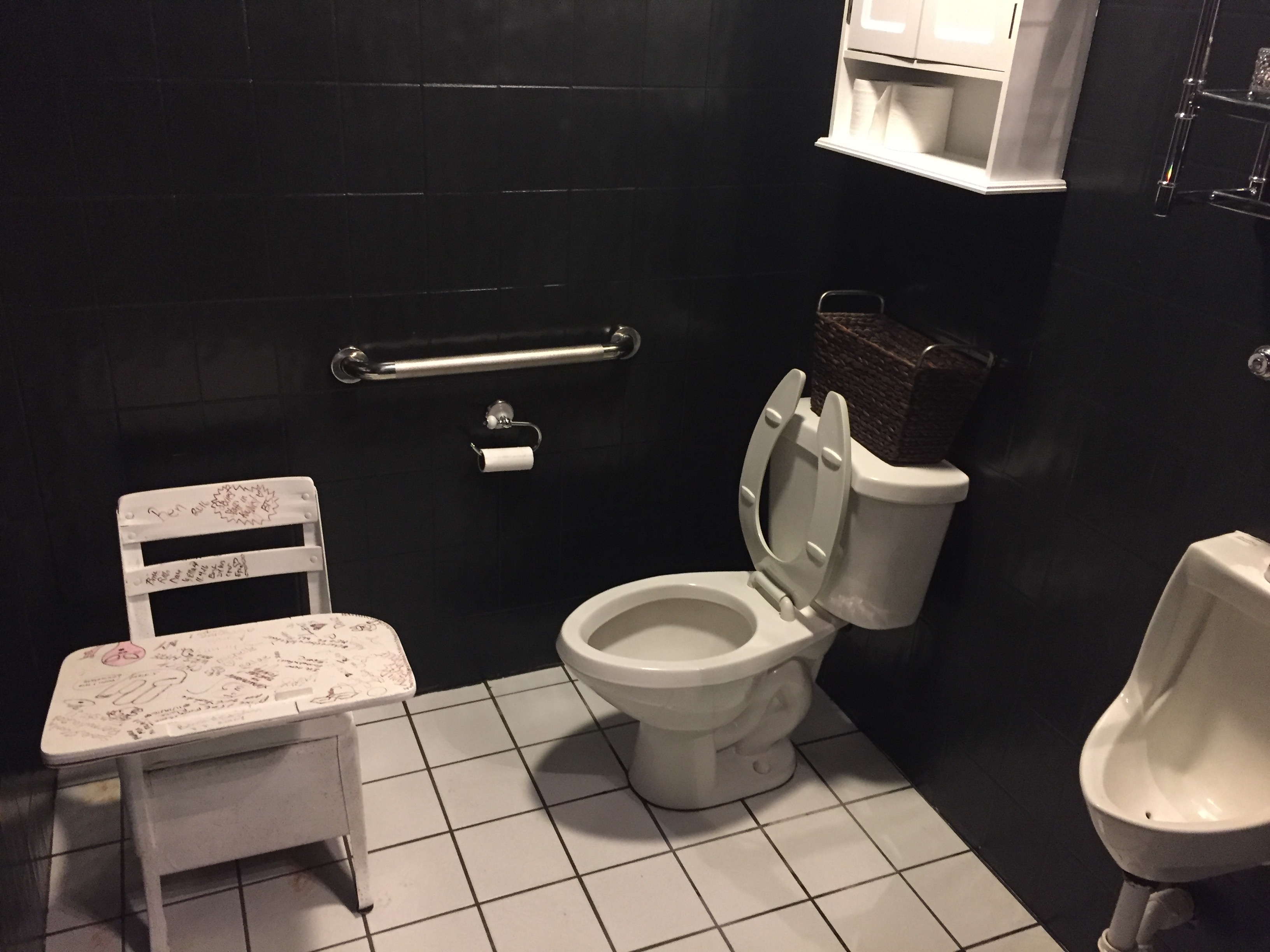
Think, for a moment, about the song: ‘The Wheels on the Bus.’ There may be no truer musical homage to journey than this. Hidden under the playful tune is a bleak and true-to-life description of what the bus, what being on the bus, is like. Strip away the notes and pretend a man, a man who has been on the bus for many hours, is speaking the words under his breath. Imagine his eyes and imagine the way his lips might move over every tired word.
Yes, the song is just a series of descriptions. Descriptions of what is happening on the bus. Examine the lyrics and you will see for yourself, the story is this:
The wheels go round and round and it begins to rain. The bus fills to the brim and the driver commands people to make more room, room that simply isn’t there. The road becomes rough, the way congested. People are leaving en masse; they are fleeing. The driver lays on the horn and a child begins to cry. The parents try, in vain, to comfort it.
What is happening here, exactly? Why was it necessary to write a song and why, if the tune is cheery, does the author describe the worst aspects of a bus ride?
I am in a bad mood.
‘Old maps and adverts in the central office detail the early days of the ‘Plains to Coast Quick Bus Co.’ how it started with many buses and many routes until, as though tending to a bonsai tree, the founders quickly trimmed it down to its truer form. It is a 17 and a half hour beast of a ride that does not go out of its way to make you comfortable.
But it is the only public vehicle allowed through the ‘Dull Moon Pass.’
Amateur Gray Road Theorists are quick to use the ‘Dull Moon Pass’ as evidence to their claim but the time it takes to traverse the DMP (satellite images reveal) corresponds closely with its theoretical length. In short, they are grasping for seconds at best. That, of course, is the trouble with Gray Road Theory. Even if it were true, the touted ‘known examples’ would hardly be useful or interesting given the small size of their estimated anomalies, no matter how precisely those distortions are calculated or how forcefully those calculations are shoved under your nose.
All that said, the DMP does fit the bill in other ways. Around fifteen minutes in it’s safe to expect color blurring and dizziness, precursors to a creeping grayout. Those who remain able to see will occasionally report a small town, often at the 45 minute mark. This would place it at the base of the ridge, shortly before the bus enters the tunnel.
There is nothing to be said about the tunnel itself accept for a near universal feeling of dread that comes upon the riders like a motion-sickness, climaxing just as the bus bursts back into full-sighted daylight. There is no clear danger and no clear change but the darkness of the tunnel clings like guilt and it insists that something has changed, that you have done something wrong in your passing. You will not feel welcome on the ‘Dull Moon Pass’ a second time. You may not feel welcome anywhere for a long time after.’
-traveler
“You’ve lost another tooth,” I tell him, though I’m sure he must know. It doesn’t surprise me when his answer takes the form of a short, dismissive nod. He nods again after a moment, a nod to himself, as though confirming some internal dialogue.
I wonder what that must sound like.
The stranger’s shadow is long and varied under the streetlights. People seem to unconsciously avoid its perimeter, mistaking it for a murky puddle in their peripheries. I prod it with the toe of my shoe when he isn’t looking and, though there is nothing underneath but pavement, the stranger turns quickly and shudders.
“What are you doing?” he asks.
“Waiting for you to decide which way to go.”
“How do you usually do this?”
“I just walk in and wait until something happens.”
He sighs and takes another step toward the cordoned-off street beyond which lies several blocks of happy, smiling people. Before us is a sign: “Welcome to the Springfield Night Market!”
‘Yes, the people seem to be happy and they seem to be smiling but, reader, do not believe that either is truly the case. The ‘Springfield Night Market’ is a place of debauchery, comparable only, perhaps, to the infamous ‘Uptown Festival of Greek Cuisine’ before it burned to the ground and was discontinued.’
“Was that you?” I ask the stranger, pointing to the passage.
“Of course not,” he says, his shadow wavering guiltily, “That must have happened before the book was published.”
As ever, I’m not entirely sure that’s the case.
‘To fully grasp the corruption at the heart of the ‘Springfield Night Market,’ one must step back and consider the very convention of the ‘night market’ itself. No mere place of commerce, a night market is the vampire’s teeth of American consumerism, emerging from the shadows to pierce the busy veins of a city and to drain them endlessly. Fledgling night markets gorge to bursting and fail but the ‘Springfield Night Market’ is ancient and clever.’
“Do you also think that the author’s militant anti-capitalist rants sometimes make it difficult to figure out when a place is actually dangerous?”
“Yes,” he says, “Just skip down to the end.”
‘The simple answer, reader, is that you must be rude to leave the market. You must ignore the merchants as they debase themselves and you must walk in a determined line until the noise of the crowd dims and you find yourself alone once more. Despite threats to the contrary, nothing will follow you past the confines of the market unless you make the mistake of purchasing it.’
“What the hell is that?” the stranger asks, returning from an extended reconnoiter of the market.
“An elephant ear,” I tell him, “I thought we could share.”
“The book says not to buy anything!”
“The book says not to buy anything you don’t want following you,” I shrug, “Do you think this is a haunted elephant ear? Do you think a piece of bread can be cursed?”
“I don’t want any,” he says, which suits me well enough.
The thing cost eight dollars.
The stranger has never asked, in any direct way, where I received my copy of ‘Autumn by the Wayside’ and his not-asking has kept me quiet on the subject as well. His copy, I’ve noticed, is further along in life than mine. So broken is the binding that, sat on a table, his copy of ‘Shitholes’ forms a near-perfect circle of splayed pages, no longer able to contain itself. Pieces are missing, like the page he gave me with his number. He seems to know, without looking, which parts of the book are no longer necessary. He loses them like teeth.
We enter together.
The cramped aisles of the night market press the stranger and I close. We lose and re-find each other between hopeful artists and honey vendors. He picks at the elephant ear disapprovingly while people trip over his shadow. I get the feeling he could disappear if he wanted to, disappear like he did in the cave.
Which means he doesn’t want to, not today.
“Sir,” someone whispers, “Sir!”
The stranger has gone.
“Sir!” a man says, indicating me to his table where he puts on a louder voice, “I’ve got something you might be interested in.”
The man is selling plants, or selling intricate plant holders that seem, incidentally to be occupied by succulents. ‘Tom’s Plants,’ the sign says, ‘You can’t kill’em!’
“That’s a bold statement,” I tell him.
“Is it?” he asks.
“I mean, doesn’t that instigate people? Won’t people try to kill your plants to prove you wrong?”
“They can try,” he says, “But they can’t.”
“You’re saying that a person could not kill one of your plants, even if they tried.”
“That’s right,” he says, “It’s more than right, it’s guaranteed!”
“Guaranteed for life?”
“We don’t offer exchanges on plants that die of natural causes. Old age, for example, is not covered. Would you like a demonstration?”
“A demonstration of what?”
Tom pulls a hammer from under the table and swiftly crushes a succulent, artsy pot and all, with several deafening blows. Passerbys watch, curiously, but scatter when he’s finished, afraid that loitering might accidentally convey interest in buying. By the time Tom is finished, the succulent is a jelly and the pot is dust.
“That seems dead, to me,” I tell him.
“Not yet,” he says, “But probably soon. In this instance, given this level of damage, we would likely offer you a refund. As I said, we have a guarantee.”
“So the “can’t kill’em” is mainly a marketing gimmick?”
“Mainly,” he says with a bizarre emphasis.
I look around for the stranger, but he has not returned.
“Mainly but not entirely?” I ask.
“That’s right.”
“Is there a specific plant…”
“Our guarantee does not cover potting supplies,” he says slyly, “And it doesn’t cover the pots themselves but we do have a peculiar specimen of fern that might suit a man such as yourself. A traveler, by the looks of it…”
He seems to want something from me, then, and his eyes narrow at my hesitation.
“Do you know what this is?” he asks, smoothing the dirt and succulent powder flat. He draws, with his thumb, two small circles, one within the other.
“Circles,” I say.
“No, wait,” he says, wiping over them and starting again.
This time the outer circle is an oval, pointed at the ends.
“An… eye?” I ask.
“The all-seeing eye!” he says, expectant once again.
I nod my head appreciatively and wait for more.
“The all-seeing eye,” he says.
“Yep,” I agree.
“Do you know what this is?”
“The.. all-seeing eye?” I ask, but he gestures for extrapolation. “The eye of providence? God watching over mankind? Conspiracy? Freemasons?”
Tom’s frowning now, his own eyes narrow.
“What is this?” he asks, wiping away the eye and drawing a short squiggle. He saves me from another embarrassing assortment of answers by mimicking a walking person with his fingers.
“A path?”
“And two people, walking the same path and in the same direction and at the same speed- will they meet?”
“No.”
“But,” he says, “Upon reaching the end would they have seen the same thing?”
“Um…” I say and Tom nods encouragingly, “Mostly?”
“Mostly!” he says, “Yes, mostly! A thousand people walking a path will meet at the end with a single, blurry vision. A hundred thousand people and the vision will clarify. The path becomes easier to follow, it is worn into the ground. The vision becomes clearer, it is held aloft by those who seek it out. That is the all-seeing eye and its rays, a multitude of visions becoming one.”
“Is this how you sell plants?” I ask.
“It is how I sell a single, specific plant,” he smiles and, donning gloves, he brings a small glass jar up from under the table.
The plant inside presses desperately against the glass. A single frond has worked its way under the lid and it points at me like an accusing finger.
“A fairy fern?” I ask.
“A regional name. I grew up calling it ‘crawl grass.’ In the south it’s… ‘the devil’s such and such,’ I don’t know. Everything belongs to the devil in the south.”
“How did you know I would recognize it?”
“Because we are the two people on the same path. I have slowed and you have caught up to me. We are the two people here that share the vision.”
“Actually,” I say, pulling out my wallet to pay him, “There’s another guy you probably shouldn’t let…”
A massive plume of fire rises over the ‘Springfield Night Market.’ People scream, plastic tents shrivel and burn. Jars of honey froth over and burst. Tom stands aghast, too aghast to hand me change. I turn to leave and trip over the stranger’s shadow, tumbling into the pavement. He’s reappeared behind me and he holds out a hand from above.
I reach out to take it. “No,” he says, “Give me the stupid fern.”
“No!” I tell him, “It’s harmless.”
I wince as the rogue frond digs into my palm.
“All right, fine!” he hisses through the gaps in his mouth, “Let’s just go.”
I take his hand and he pulls me from the ground. We start to weave through the crowd, fingers intertwined, and as the stranger leads me away I hear Tom shouting. It’s difficult, at first, to make out, but what I hear is this:
“He’s running!” Tom shouts, “He’s running backwards on the path!”
-traveler
“Traveler,” the radio cracks, “Traveler.”
“What do you want?”
“What do you want?” it asks, “You don’t look so well, traveler. You look sick.”
“It took you a while to get here.”
“It doesn’t take me any time to get anywhere. You know that as well as me.”
“Well it took you some time to speak up.”
…
“Where are we, traveler? It’s dark here.”
“Shitty hotel.”
“We’ve been here for a while, in the dark.”
“That’s what I was saying.”
“If you are not traveling, then I don’t know what to call you.”
“We’ll hit the road again once I’m better. No need to think up a new name.”
“Still…”
…
“Would music help you, mmm, traveler?”
“No.”
“Would cleaning up help the smell?”
“Are you offering?”
“I am not.”
…
It’s three days before I open the window, a few days longer before I turn the bolt in the door. I am gone long enough to get ice. My legs are still weak and the day is bright and painful. The world has taken on a foreign smell, not a pleasant one. Or else that’s me relative to the new freshness.
Yes, a moment’s investigation confirms it is me.
I hurry back.
The door to my room is ajar; did I leave it that way? It is only open a crack, hardly enough for a passerby to notice. Hardly enough to let in air. It’s the space left when a closed door doesn’t quite latch, or when a trespasser doesn’t want to make a sound. Closed, but for being open.
I push inside.
The room is thick with human evaporations, with sweat and feces and, distantly, with cigarette smoke. This is a dim place, a place that resists light. The bathroom door is closed and light seeps out between the cracks. There may have been movement there as I watched but, now the subject of my focus, the room pleas vacancy.
If only there were a window.
“Is it here?” I ask into the darkness.
The radio, improperly adapted to the wall socket, buzzes and pops. The lights in the hallways flicker.
“Is what here, traveler?”
There is movement in the bathroom, I see it again.
“It might be best if you close the door, traveler,” the radio says, “It is unhealthy to linger between spaces.”
“That’s not…”
Another movement in the bathroom, the sound of a cabinet quietly closing.
“You are still not well. Is it not my duty to remind you?”
“You’re supposed to warn me when something breaks in here too.”
“There is nobody but yourself here, traveler. Even I, by most definitions, am not where you are.” The radio laughs at this, “Heh, heh, heh.”
I hear the sound of a toilet seat dropping, the rustle and tear of toilet paper.
“There is something in the bathroom, I mean. Don’t you hear that?”
The voice is quiet for a moment and I assume it’s listening. As the moment grows longer I realize it has simply chosen to end the conversation. I stand alone with the thing until, against my better judgment, I slip inside and close the door, close and latch to banish whatever liminal space may have existed. In the failing confidence of my decision I feel my heartbeat, quick with fear and anticipation.
I start the coffeepot and wonder if one evil might provide respite from another. The thing in the bathroom quiets down, some. The door there is like the last, closed but unlatched. Tenuously open.
The wayside is a place for things we’ve forgotten or failed to do and as I travel here I find it difficult to see past my own failings, or, I suppose, to discern them from the successes I carry with me. In a place littered with broken bottles and used needles, things that jab and poke and hook into your soles, it’s hard to tell if you’re being followed or if you’re just dragging something behind you.
I’ve begun to understand that mine is the latter case.
The toilet flushes and I hear the too-friendly jingle of a belt. Inside, the thing stands and pulls faded jeans up over its pale, distended belly. Its movements are lazy and vulgar, its breathing deep and steady. The hairs on my arms prick up as I hear it splash its hands about in the sink. My own body is itching and sick.
I remember the ice, now half-melted. I make a cool rag with one eye on the bathroom door. I climb into bed, between the damp sheets, and I cover my face.
“Traveler?” the radio clicks, “Traveler? Should I still warn you when something is coming? Will you believe me when I say there is nothing?”
“Yes,” I say under the rag, “Sure.”
“There is nothing now, traveler. Nothing now or before.”
-traveler
Recent Comments